It’s analog, it’s compact, it’s enduring, and it’s still just about affordable: Oberheim’s budget synth expander from the company’s dying days sold by the truckload—and remains a cult favourite on the second-hand market, though not too cult. Let’s crack open the Matrix-1000 and see what this 40-year-old hardware can (and can’t) do. What should you watch out for, and what can modern tech do to drag it into the 21st century?
Rough, machine-aided translation from my German reader’s story in Amazona.de magazine.
“Does even impress the guitar player—and packs enough punch to blast that annoying species off the stage!” That closing line from German Keyboard magazine’s Matrix-1000 review burned itself into my memory, right alongside the price tag: 1,000 Deutschmarks. Peanuts by today’s standards—it’s still one of the cheaper analogue synths around. But as a student, I could only afford one after Oberheim’s fire-sale clearance dumped one of the many, many, many units they’d churned out onto my doorstep. This was the early ’90s, mind you, when analogue synths were about as fashionable as mullets.
A synth expander with zero onboard programming: what was once the Matrix’s biggest flaw is now a non-issue, thanks to cheap, capable MIDI controllers. Back in the late ’80s, they just weren’t available. Most computers of the era lacked MIDI ports—bar the Atari 1040 ST—and soldering together my own interface was well beyond the tinkering skills of teenage me. Maybe that’s why I’m still fiddling with the thing today. Late revenge, you might say.
Inside the Matrix-1000: What the analogue can do
Let’s cut to the chase: the Matrix-1000 is quite robust. We will get to it few weak spotslater. Helping matters is the lack of moving parts; as any electronics veteran knows, switches, knobs, and sliders are the first things to fail in vintage gear.
Technically, the Matrix consists of six single-chip analogue synth voices, each built around a Curtis CEM3396—a 24-pin DIP that packs two oscillators, a waveshaper, a filter, and two VCAs, needing only an external clock and control voltages to make noise. The filter is 24dB, lacking the classic 12dB Oberheim squish of an OB-Xa. (But yes, you may still use it to play the “Jump” hookline until they boot you out.) A bandpass or highpass mode is theoretically possible but not implemented here—just a single lowpass, end of story. Take note: those custom chips and their control circuitry are the Matrix’s Achilles’ heel.
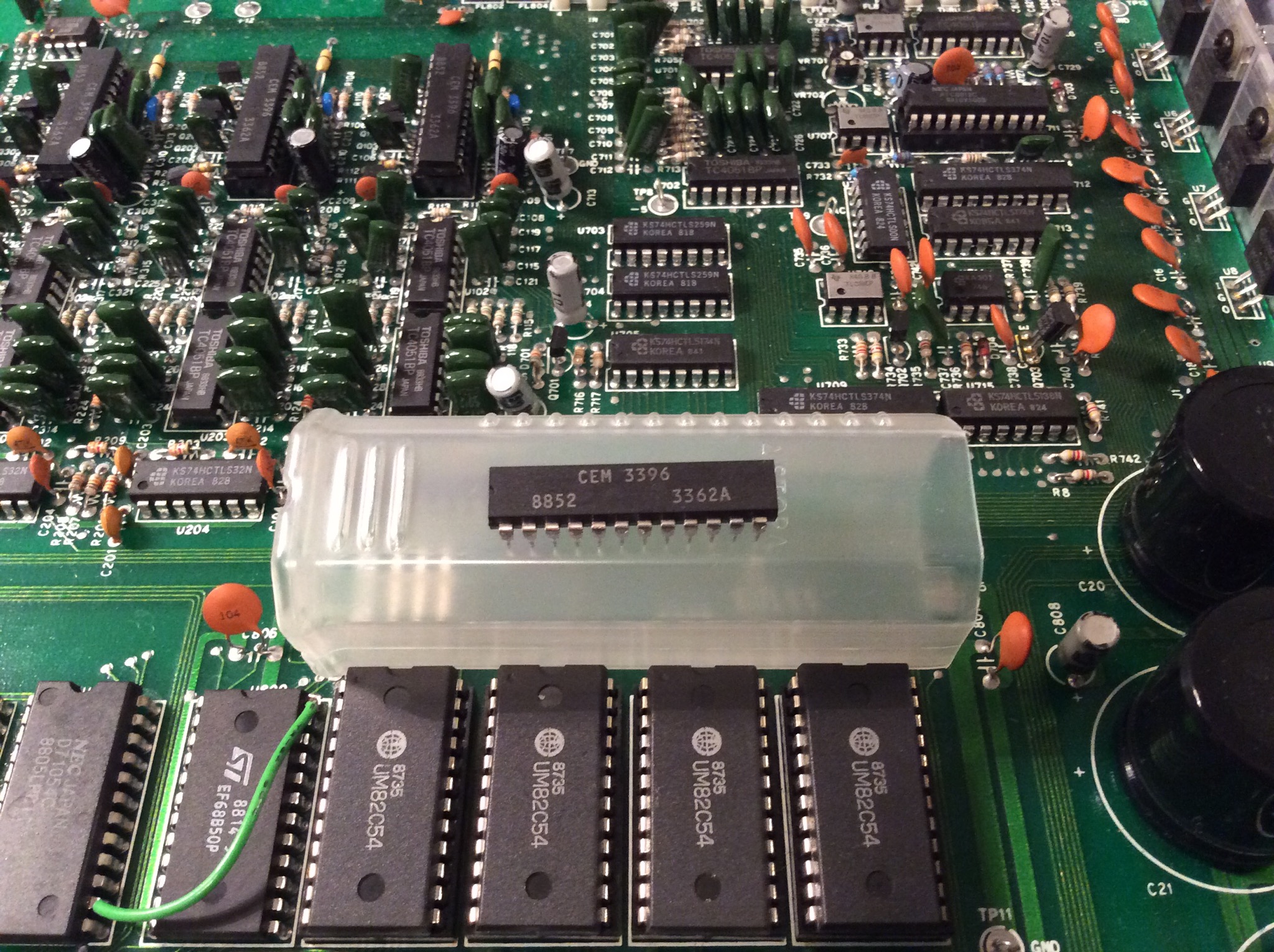
Catch me if you can: This Curtis CEM3396 synth-on-a-chip is faulty. Unfortunately, they are extremely rare these days.
FM—modulating one oscillator with another—isn’t on the menu, but the designers did enable filter FM, letting you modulate filter frequency with an oscillator. Soft and hard sync are also constructed around the chip’s circuitry. The noise generator is discrete, mixed into each voice via a dedicated input on the CEM chip.
All six voices sum to a single mono output: no bitimbral splits like its predecessor (the Matrix-6), no panning, no effects. Just dry, unadulterated signal—part of why the Matrix cuts through the mix like a T-800 in a biker bar.
Inside the Matrix-1000: What the ’80s computer tech can (and can’t) do
Wrapped around those six voices is a control computer with the specs of its era—think Commodore 64: an 8-bit 6809 CPU clocked at 2MHz. No coprocessor, no DSP, and very limited number-crunching power.
Yet the Matrix punches above its weight. Control voltages update at 50Hz, meaning envelopes and LFOs recalculate every 20ms. What that means: the fastest attack is 20ms (audibly sluggish), and LFOs in the audible range are out of the question.
The 8-bit CPU has a 64KB address space, so the entire OS and patch memory must fit here. (For perspective, a single iPhone photo gobbles up 50 times that memory.) The Matrix’s firmware squeezes into 32KB—32,768 bytes—using every dirty programming trick in the book. Patch storage shares another 32KB. To cram 1,000 sounds into that tiny space, the CPU bank-switches between memory chips.
Flash storage? Didn’t exist. Consequences:
- Firmware updates require swapping a ROM chip—no MIDI uploads. Luckily, the necessary 27C256 chips are still available, though you will need special gear for programming them.
- Battery backup: To retain settings, a CR2032 battery (soldered in, because Oberheim pinched pennies) keeps the memory alive. When it dies—and it will—you’re in trouble.
Firmware, Firmware, Firmware! And bugs.
On turning on, most Matrix-1000s display 1.11, the version number of the last official firmware. A few early units show 1.03, hinting at a hardware mod needed for upgrades. And upgrades are worth it—partly thanks to yours truly; I had a big mouth in a forum which may have goaded Bob Grieb into cooking up v1.20. But more on that later.
The original coders—including future Line 6 founder Marcus Ryle—knew their stuff. The firmware’s party piece is the namesake modulation matrix: 20 sources routing to 32 destinations, plus three envelopes, two LFOs, two ramp generators, and a “tracking generator” (a waveshaper for mod sources). There are so many hardwired mod routes, it’d make a Minimoog weep.
But the original firmware has bugs. v1.11’s worst offences:
- Parameters 29 (ENV2 to VCA) and 53 (ENV1 Sustain) are broken and can crash the synth.
- Tweaking parameters like the filter resonance too fast overwhelms the CPU, causing notes to stutter as unprocessed parameter changes clog the input buffer.
The fixes:
- v1.13 (Nordcore): A German hacker patched three bytes, fixing the ENV bugs and enabling real-time filter sweeps.
- v1.16 (GliGli): A French hacker added a “no new commands until the last one’s done” rule, stopping buffer overloads. Bonus: Unison Detune via CC#94.
- v1.20 (Bob Grieb): Rewrote critical routines in Verilog, speeding them up to stay under 20ms. Also fixed NRPN and added GliGli’s Unison Detune.
- v1.21: Changes one bit to restore a lost feature—”Reassign/Rob” voice-stealing mode.
Swapping firmware means unscrewing eight case screws and replacing the ROM. It won’t turn the Matrix into a modern synth, but it’ll make it much more fun to play.
Total conversions: Pushing the hardware further
GliGli tried overclocking the CPU, but it risks destabilising other chips. Not recommended.
Kiwitechnics’ now-discontinued kit replaced the guts with a new brain, adding a third LFO and arpeggiator. Requires soldering, but it’s doable.
Weak spots: What to check in a used Matrix-1000
After 40 years of ownership and tinkering, I can say: the Matrix is tough and repairable. Most of it is CMOS logic—still available today. But watch for:
- Transformer hum: The power supply’s old-school trafo vibrates the case. Fixes: swap for a toroidal transformer, stuff the case with damping material, or buy a later white model (quieter).
- Dead CEM3396 chips: If a voice cuts out, diagnose with the built-in test mode, then replace the faulty chip. Pro tip: Buy the narrow-body 3396, not the Matrix-6’s wide version.
- Dead battery: When it fails, patches corrupt or the synth won’t boot. Fix: Desolder the original, install a battery holder. (Static discharge during firmware swaps can flip memory bits—fun!)
- Capacitors: Unlike many vintage synths, I’d only replace caps if they’re bulging or smelly. The Matrix isn’t plagued by leaky electrolytics.
(Full disclosure: I sell Bob Grieb’s firmware chips and pay him a licence fee. But I’d still write this even if I didn’t.)
Final verdict? The Matrix-1000 is a survivor—a no-nonsense analogue workhorse that, with a few tweaks, still holds its own. Just don’t expect miracles.